Pneumatic Solutions
Comprehensive pneumatic automation components for machine building and factory automation. We supply high-quality air cylinders, directional control valves, air preparation units (FRLs), and fittings from global leaders like Festo, SMC, and Janatics.
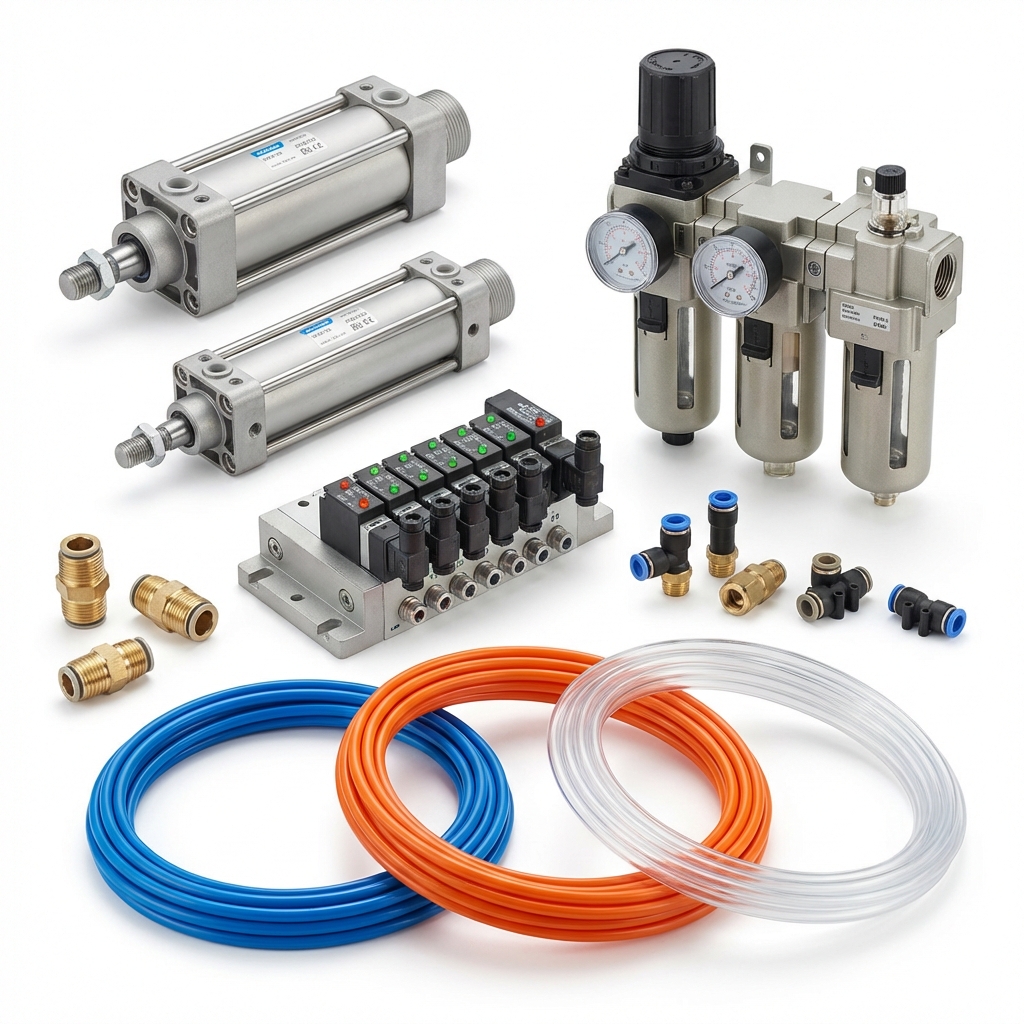



Pneumatic Components
Complete air logic and motion control components for industrial machinery
Air Cylinders & Actuators
Robust pneumatic cylinders for linear and rotary motion. Built to ISO 15552, ISO 6432, and VDMA 24562 standards ensuring global interchangeability and long operational life.
Solenoid & Control Valves
Directional control valves for directing compressed air to actuators. Available as individual valves or as multi-valve manifolds with multi-pin/fieldbus connectivity (Profibus, Profinet).
Air Preparation (FRL Units)
Filter, Regulator, and Lubricator (FRL) assemblies are essential to remove moisture and dust from compressor air, control working pressure, and supply oil mist to mechanical parts.
Push-in Fittings & Connectors
One-touch quick connect pneumatic fittings that ensure secure, leak-free connections between tubing and components. Stainless steel gripping rings allow rapid disconnection.
- Thread Types — BSPT, BSPP (G-thread), Metric
- Shapes — Straight, Elbow, Tee, Y-connectors, Bulkhead
- Materials — Plastic body (PBT), Brass, Stainless Steel
- Tube Diameters — 4mm, 6mm, 8mm, 10mm, 12mm, 16mm
PU & Nylon Tubing
Flexible pneumatic hoses for air transmission. Polyurethane (PU) offers extreme flexibility and kink resistance, while Nylon (PA) provides higher pressure and chemical resistance.
- Polyurethane (PU) — Standard 98A shore hardness
- Nylon (PA12) — For semi-rigid fixed piping applications
- Teflon (PTFE) — High temperature (up to 260°C)
- Colors — Blue, Black, Clear, Red, Green (roll lengths: 100m)
Pneumatic Accessories
Auxiliary components essential for optimizing and monitoring pneumatic circuits, extending machine life, and improving safety.
- Flow Control Valves — Meter-in and meter-out speed controllers
- Proximity Sensors — Magnetic reed/solid-state for cylinder slots
- Silencers (Mufflers) — Sintered bronze & plastic noise reduction
- Quick Exhaust Valves — For rapid cylinder retraction
How to Select Pneumatic Components
Key sizing parameters for cylinders and valves
Sizing a Pneumatic Cylinder
To determine the correct cylinder bore size, you must calculate the required force. The theoretical force depends on two factors: the Operating Air Pressure (usually 6 bar / 90 PSI) and the Piston Surface Area (π × r²). Always add a minimum safety factor of 30% to 50% to account for internal friction and dynamic loads. E.g., if a load requires 50 kg of pushing force (~500N), calculate the required bore size at 6 bar, factoring in the safety margin.
Choosing the Right Valve (3/2 vs 5/2)
The type of cylinder dictates the valve type. Single-acting cylinders (which use an internal spring to return) only need one path for air, so they require a 3/2-way directional control valve (3 ports, 2 positions). Double-acting cylinders (powered in both directions) require air paths for both extending and retracting, so you must use a 5/2-way directional control valve (5 ports, 2 positions). For mid-position stopping capabilities, use a 5/3-way valve.
Industries Using Pneumatics
Air-powered automation across different manufacturing sectors
Machine Building (OEM)
Supplying Festo and SMC valve manifolds and ISO 15552 standard cylinders for packaging machines, SPM (Special Purpose Machines), and assembly lines in MIDC Waluj and Pune.
Pharma & Food Processing
Providing clean-design, corrosion-resistant stainless steel cylinders, FDA-approved PTFE tubing, and washdown-rated valves for hygienic manufacturing environments.
Automotive Manufacturing
Heavy-duty clamping cylinders, pneumatic grippers for robotics, and robust FRL units ensuring dry, clean air for pneumatic tools on automotive assembly lines.
Material Handling
Pneumatic logic and actuation for sorting conveyors, diverters, pick-and-place gantry robots, and vacuum-operated lifting systems in logistics hubs.
Pneumatic Standards
Your Technical Pneumatics Distributor
100% Original Products
We source directly from manufacturers. Guaranteeing no counterfeit Festo or SMC parts, ensuring your machines run safely without catastrophic pneumatic failures.
Local Stock Availability
We maintain deep inventory of standard stroke cylinders, 5/2 valves, standard PU tubing sizes, and fittings at our Maharashtra warehouse to solve breakdown emergencies.
Technical Equivalent Mapping
Trying to replace an obsolete imported cylinder? Send us the nameplate! Our engineers can cross-reference and map technical equivalents from Festo, SMC, or Janatics within hours.
Integration with Electricals
As an end-to-end automation supplier, alongside pneumatic valves we provide the PLCs, control cables, and terminal blocks needed to wire them up.
Frequently Asked Questions
Expert clarification on air cylinders, valves, and fittings
What is the purpose of an FRL unit?
An FRL (Filter, Regulator, Lubricator) unit prepares compressed air before it enters your pneumatic circuit. The Filter removes moisture, dust, and rust that could jam valves. The Regulator reduces the fluctuating compressor line pressure to a stable, usable working pressure (e.g., 6 bar), saving energy. The optional Lubricator injects a fine oil mist into the air to lubricate the internal seals of cylinders and tools, though many modern cylinders are pre-lubricated for life and don't need it.
How does a push-in fitting work without leaking?
Push-in fittings contain an internal stainless steel gripping ring (collet) and an NBR O-ring. When you push the PU or Nylon tube into the fitting, the O-ring seals the outside diameter (O.D.) against the air pressure, while the metal teeth of the collet bite into the tube, preventing it from blowing out under pressure. To release, simply push the plastic release ring down, which opens the collet teeth, allowing the tube to slide out.
What is the difference between Single-Acting and Double-Acting cylinders?
A Single-Acting cylinder uses compressed air to create force in only ONE direction (extending). An internal mechanical spring pushes the piston back to its starting position when air is removed. A Double-Acting cylinder has no spring; it requires compressed air applied to separate ports to forcefully extend AND forcefully retract. Double-acting is the industry standard due to higher reliability.
Why use a 5/3-way valve instead of a 5/2-way valve?
A 5/2 valve has two positions: fully extended or fully retracted. A 5/3-way valve has a third, center "neutral" position. When the electrical signal is removed, a spring forces the valve to the center position. Depending on the valve design (Closed Center, Exhaust Center), this allows a double-acting cylinder to be stopped and held at intermediate points mid-stroke, which a 5/2 valve cannot do.
Why are my pneumatic cylinders moving erratically or "jerking"?
This is known as "stick-slip" and is usually caused by two things: 1) Lack of a flow control valve (speed controller). Pneumatic air is highly compressible; without throttling the exhausting air (meter-out control), the cylinder will move violently. 2) The internal piston seals have dried out or been damaged by dirty, un-filtered air, increasing friction.
What is an ISO 15552 cylinder?
ISO 15552 is a strict international standard defining the mounting dimensions, thread sizes, and stroke lengths of pneumatic profile cylinders. The advantage is 100% interoperability. An ISO 15552 cylinder from Festo will bolt into exactly the same machine mounting holes as an ISO 15552 cylinder from SMC or Janatics, allowing factories to switch brands easily if parts become obsolete.
Can I use PU tubing for high-pressure hydraulic oil?
Absolutely NOT. Standard Polyurethane (PU) and Nylon pneumatic tubing is designed strictly for compressed air or vacuum up to 10 Bar (145 PSI). Hydraulic systems operate with oil at exponentially higher pressures (usually 100 to 300+ Bar). Using pneumatic tubing for hydraulics will result in an immediate burst, causing equipment damage and severe injury.
How are flow control valves installed? Meter-In or Meter-Out?
In pneumatics, you almost always use Meter-Out installation. You achieve smooth, controlled speed by throttling (restricting) the air exhausting out of the cylinder, allowing the incoming pressure to push against a cushion of air. Trying to restrict the incoming air (Meter-In control) with compressible gases leads to erratic, jumpy "stick-slip" motion.
Need Pneumatic Automation Support?
Get expert sizing for cylinders and valves with competitive pricing.